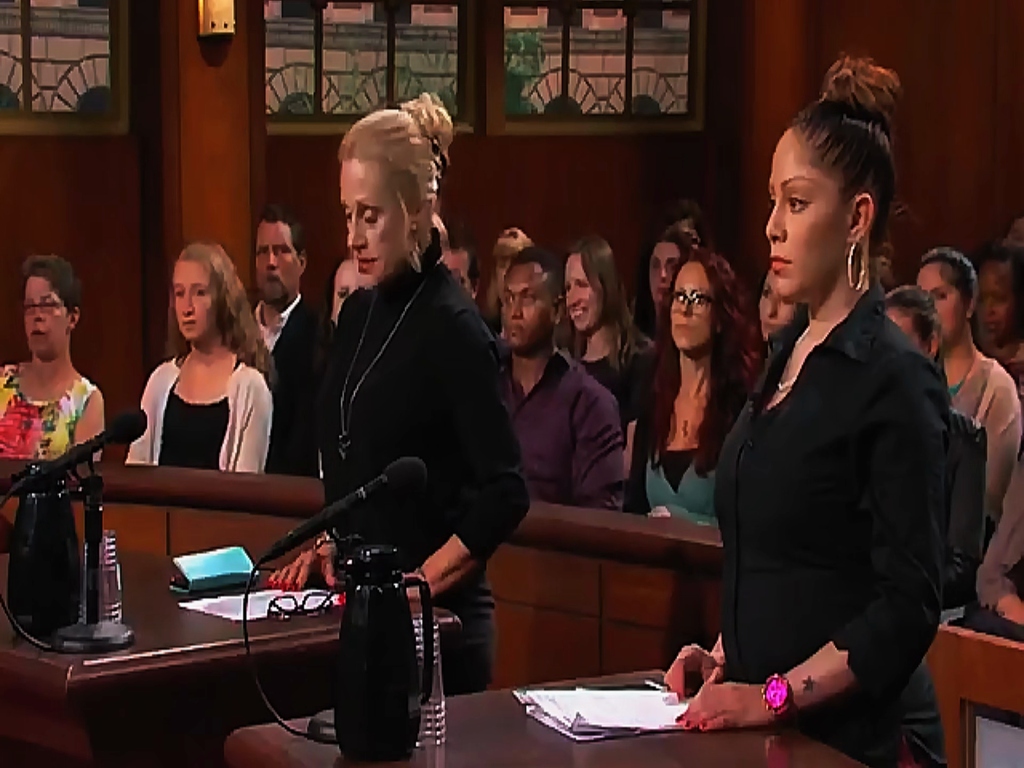
The marshals were already at the apartment, belongings were being put outside, and the eviction process was no longer an abstract threat. Faced with losing her home, the defendant turned to a neighbor for help. That neighbor went to the bank, withdrew her own money and paid approximately $2,357 directly toward the rent. A month later, after receiving a tax refund, the defendant returned $2,000 — but insisted the remaining $357 had essentially been forgiven. Judge Judy had one problem with that explanation: why would a woman who barely knew her simply give away the rest of the money?
(uc.)
The Eviction Was Already Happening
By the time the plaintiff stepped in to help, the defendant’s housing problem had reached an urgent stage. Judge Judy established that the defendant was not merely worried that an eviction might happen sometime in the future. According to the testimony, the marshals were actually there and her belongings were being removed from the apartment. She had previously received notice and had gone through the eviction process, so the situation should not have come as a surprise.

Judge Judy made a point of distinguishing between not knowing an eviction was coming and not wanting to believe it would actually happen. The defendant had been given notice and understood the process, but when the consequences finally arrived, she needed money immediately. That was when she turned to the plaintiff, a neighbor who was willing to do something unusually generous for someone Judge Judy suggested she barely knew.

The plaintiff did not merely hand the defendant a few dollars or promise to help later. She went to her bank, withdrew the necessary funds and obtained a money order payable to the landlord. The payment was approximately $2,357, and it was made on February 17. Its purpose was clear: to cover the defendant’s rent and attempt to stop the eviction.

There was no meaningful dispute over whether the plaintiff had provided the money. The defendant acknowledged that her neighbor had paid the rent. The only real question was how much of that money still had to be returned.
A Neighbor Uses Her Own Money to Help
Judge Judy repeatedly emphasized the nature of the plaintiff’s decision. This was a woman who had gone to the bank and used her own funds to help a neighbor facing a housing emergency. She was not charging interest, operating as a lender or attempting to profit from the defendant’s crisis. She simply stepped in when the defendant needed help.

That fact became important because the defendant later tried to characterize the remaining balance as something the plaintiff had agreed to let go. Judge Judy found that difficult to believe. If the plaintiff had intended to give the defendant hundreds of dollars as a gift, there needed to be some convincing explanation for why. Instead, the transaction looked exactly like what the plaintiff said it was: a loan made to help the defendant avoid immediate eviction.

The amount discussed repeatedly in court was $2,357. The transcript contains a garbled automatic-caption reference around the exact money-order figure, but the subsequent testimony consistently treats the loan as $2,357, with $2,000 repaid and $357 remaining. Judge Judy used those same numbers in reaching her judgment.
The defendant also acknowledged the fundamental arrangement. She had received the benefit of the plaintiff’s money, and she later paid back most of it. That partial repayment would make her claim about the remaining $357 even harder to defend.
A Tax Refund Arrives — and $2,000 Is Repaid
The defendant expected a tax refund, and when that money arrived, she repaid the plaintiff $2,000. Judge Judy established that the repayment happened roughly one month after the original loan. In other words, the defendant received more than $2,300 in emergency assistance in February and returned $2,000 shortly afterward.
The plaintiff was now asking for the remaining $357.

From Judge Judy’s perspective, the arithmetic was simple. If someone loans you $2,357 and you return $2,000, you still owe $357. The defendant did not dispute receiving the benefit of the original payment or repaying only $2,000. Instead, she offered a different defense: she said the plaintiff had indicated that after the $2,000 payment, the rest of the debt was “squashed.”

Judge Judy immediately challenged that explanation. Why would the plaintiff forgive $357 after already going out of her way to help? This was not a close relative or lifelong friend who had deliberately offered financial support without expecting full repayment. Judge Judy characterized the plaintiff as someone who barely knew the defendant, yet had still withdrawn her own money to prevent an eviction.
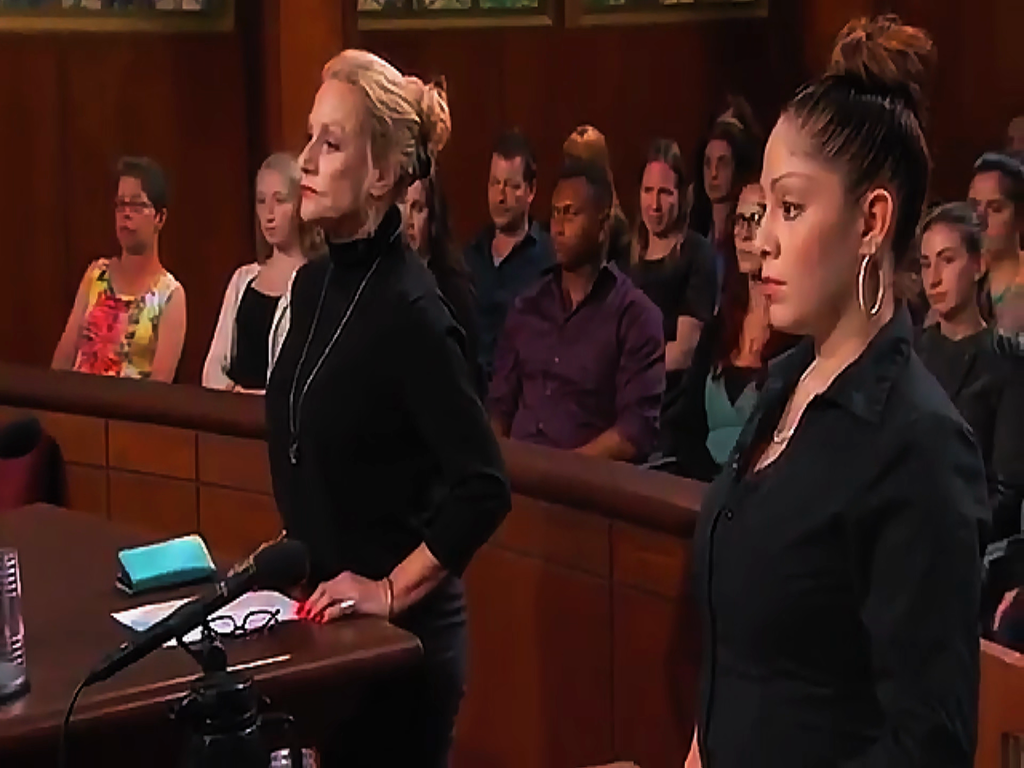
The defendant said the plaintiff understood the difficult situation she was in. Judge Judy was not persuaded that understanding someone’s financial hardship automatically cancels part of a debt.
Judge Judy Questions Why $357 Would Simply Disappear
The defendant’s position became particularly difficult when Judge Judy walked through the numbers aloud. The plaintiff had provided $2,357. The defendant had returned $2,000. Therefore, she should have returned another $357. When Judge Judy put the issue that directly, the defendant acknowledged the basic logic.

The judge then wanted to know how much the defendant had received from her tax refund. The transcript renders her answer incompletely as “24,” making the exact amount uncertain, so it would be inappropriate to convert that fragment into a specific dollar figure. What is clear is that the defendant had received a refund large enough that Judge Judy questioned why she had not simply paid the plaintiff the entire $2,357 she owed.

Instead of saying she lacked access to the refund, the defendant explained that she had offered the plaintiff the debit card on which she received her tax refund. The plaintiff did not want the card.
For Judge Judy, that was not a valid excuse for withholding the balance.
The plaintiff had not originally given the defendant a debit card. She had gone to the bank and arranged payment of the defendant’s rent in actual U.S. dollars. Judge Judy humorously emphasized the point by saying the plaintiff had not paid her rent in “Wampum,” pounds sterling or Green Stamps. The transaction involved money, and repayment should likewise have been made in money.
The Debit Card Defense Goes Nowhere
The defendant explained that obtaining a cashier’s check would have cost approximately $50 per thousand dollars, a fee she considered unreasonable. Because of that, she said she offered the tax-refund debit card instead. When the plaintiff refused to take it, the defendant apparently treated the situation as part of the reason she did not return the full balance.

Judge Judy rejected the reasoning. If the defendant had money available on a debit card, she could have found a way to use those funds to repay the person who had saved her from an immediate financial crisis. The fact that one particular repayment method involved a fee did not transform the remaining $357 into a gift.
The defendant again tried to emphasize that the plaintiff knew about her difficult circumstances. She also mentioned that she had a daughter and did not have much money. Those facts may have explained why she needed help in the first place, but Judge Judy did not accept them as a legal reason to keep part of the plaintiff’s money.
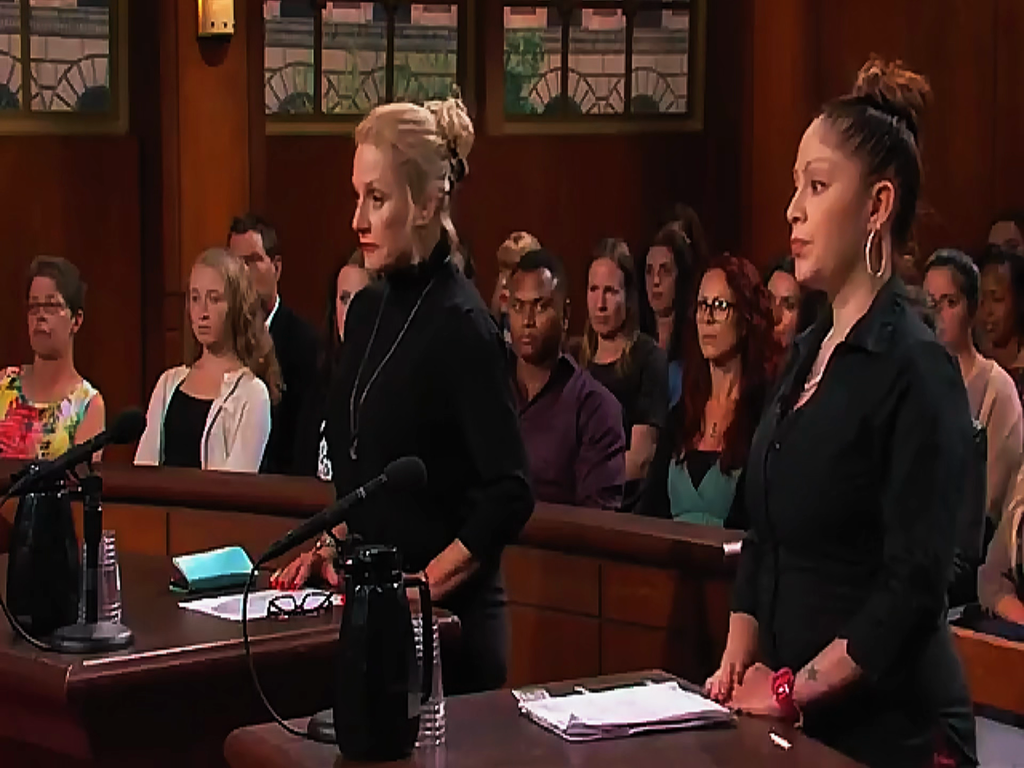
The judge’s response cut directly through the emotional argument: why was the plaintiff financially responsible for the defendant’s daughter? The plaintiff had already done something generous by paying thousands of dollars toward a neighbor’s rent without charging interest. Her kindness did not create an obligation to absorb the remaining debt.
The Attempt to Stop the Eviction Ultimately Failed Anyway
Another detail made the story even more frustrating: despite the plaintiff’s effort to prevent the eviction, the defendant was ultimately evicted anyway. Judge Judy confirmed that fact near the end of the hearing and reacted with obvious disbelief.
That did not mean the defendant no longer owed the money. The plaintiff’s loan had been used for the purpose intended at the time — paying rent in an attempt to forestall the eviction. Whether the defendant later remained in the apartment did not erase the fact that the plaintiff had spent her own money on the defendant’s behalf.

The unsuccessful outcome also highlighted the extent of the plaintiff’s generosity. She had stepped into a crisis that was not hers, used more than $2,300 of her own funds to help, charged no interest and received most — but not all — of her money back. By the time they reached court, she was not asking for thousands of dollars in additional compensation. She simply wanted the unpaid $357 balance.
Judge Judy saw no credible reason why she should not receive it.
Kindness Did Not Turn the Loan Into a Gift
The defendant’s strongest emotional argument was that the plaintiff knew what she was going through. She was struggling financially, had a daughter and was facing eviction. The plaintiff herself appeared sympathetic to those circumstances; after the hearing, she referred to the defendant’s brand-new baby and said that it had pulled at her heartstrings.
That sympathy helps explain why the loan happened. It does not prove that part of the loan was forgiven.
Judge Judy drew a clear line between compassion and financial responsibility. The plaintiff could choose to help someone in trouble without agreeing to permanently lose part of the money. In fact, the defendant’s repayment of $2,000 reinforced the existence of a loan rather than a gift. If the entire transaction had been charitable assistance, there would have been little reason to repay most of it only a month later.

The defendant’s claim was narrower: she believed the plaintiff had forgiven only the final $357. But Judge Judy did not find a convincing reason or sufficient evidence to support that version. The plaintiff was in court specifically demanding the balance, which was inconsistent with the idea that she had intentionally abandoned it.
The result became almost inevitable.
Judge Judy Awards the Remaining $357
Judge Judy entered judgment for the plaintiff for $357, exactly the unpaid portion of the loan. The ruling required no complicated calculation and no extensive analysis of damages. The plaintiff had advanced approximately $2,357, the defendant had repaid $2,000, and the remaining balance was $357.
The case was also a striking example of how partial repayment can strengthen evidence that money was originally a loan. The defendant could not credibly argue that she had never received financial assistance because the plaintiff had paid her landlord directly. She could not argue that the entire payment was a gift because she had already returned $2,000. Her defense therefore depended on persuading Judge Judy that the plaintiff voluntarily forgave only the last $357.
Judge Judy did not believe it.
Outside the courtroom, the plaintiff said she was pleased with the ruling and acknowledged that sympathy for the defendant’s new baby had influenced her willingness to help. She even expressed hope that the two could remain friends. But she added one practical lesson from the experience: she would not loan the defendant any more money.

The defendant, meanwhile, continued to emphasize that the plaintiff had known the difficult circumstances she was facing. That may have been true, but knowing why someone is struggling does not automatically mean a lender agrees to absorb the debt.
In the end, Judge Judy reduced the entire dispute to the most basic principle imaginable: when someone loans you $2,357 and you repay $2,000, the remaining $357 does not disappear simply because you are still having financial problems.
The plaintiff had already provided generosity when it mattered most. Judge Judy made sure that generosity did not cost her the rest of her money.
(uc.)
FAQ
Why did the plaintiff loan her neighbor $2,357?
The defendant was in the process of being evicted, with marshals already involved and belongings being removed from the apartment. The plaintiff went to her bank and arranged approximately $2,357 in payment to the landlord in an attempt to forestall the eviction.
How much did the defendant repay?
After receiving her tax refund roughly a month later, the defendant repaid the plaintiff $2,000. That left an unpaid balance of $357.
Why did the defendant believe she did not owe the remaining $357?
She claimed the plaintiff had essentially agreed that the matter was settled after the $2,000 repayment. She also emphasized that the plaintiff understood her difficult financial circumstances. Judge Judy did not accept that explanation.
What was the dispute over the tax-refund debit card?
The defendant said she offered the plaintiff the debit card on which her tax refund had been deposited. The plaintiff did not want the card. Judge Judy found that irrelevant because the plaintiff had originally paid the defendant’s rent with money and was entitled to receive her money back.
What was Judge Judy’s final verdict?
Judge Judy entered judgment for the plaintiff for $357, representing the unpaid balance after the defendant repaid $2,000 of the approximately $2,357 loan.
Sources
Judge Judy, including testimony about the defendant’s eviction, the plaintiff’s February 17 payment toward the landlord, the approximately $2,357 loan, the defendant’s later $2,000 repayment, her tax-refund debit-card explanation and Judge Judy’s final $357 judgment for the plaintiff. The automatic subtitles contain a garbled rendering of the original money-order amount and an incomplete rendering of the tax-refund amount; this article does not invent figures where the transcript is unclear.