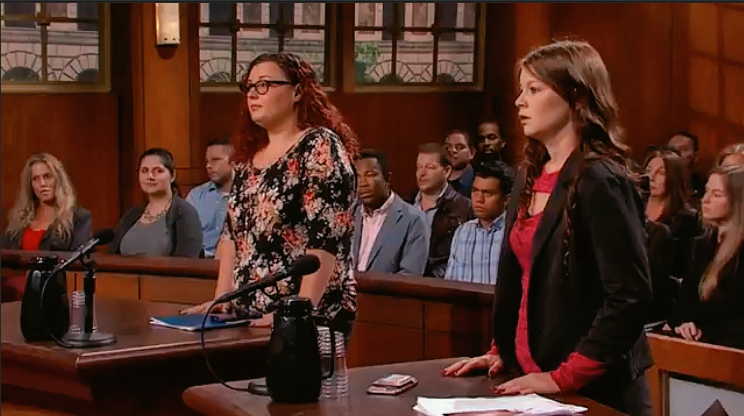
When 25-year-old Crystal Snow handed over $795 for an apartment security deposit, she envisioned a fresh start with her cousin, Kayla Frison. She never anticipated that within months, co-living would devolve into missing hot water, unannounced romantic partners, a hasty move-out under the cover of night, and a heated showdown under the fierce gaze of Judge Judy Sheindlin.
1. The Promise of Co-Living: A Shared Lease and Unspoken Expectations
In early co-tenancy agreements, blood ties often create a false sense of security. When 25-year-old Crystal Snow agreed to sign a shared residential apartment lease with her 24-year-old cousin, Kayla Frison, the arrangement seemed built on mutual trust. Under the terms of the agreement, both cousins were officially named on the lease, sharing financial accountability for the unit.
However, behind the signature on the lease was an underlying structure that quickly proved unstable. Crystal’s long-term plan included her boyfriend moving into the unit as soon as he completed a residential rehabilitation program. This understanding served as the foundational premise for Crystal’s living arrangements.
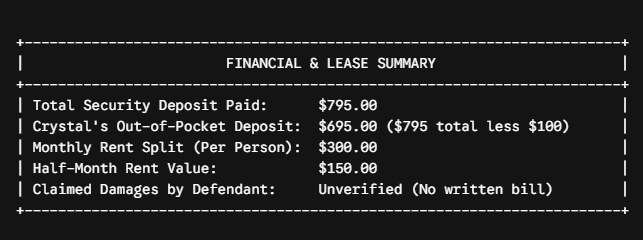
Yet, as with many shared living situations involving family, the line between legal obligations and personal expectations began to blur almost immediately. A security deposit totaling $795 was required by the landlord to secure the dwelling. Crystal stepped up to cover the vast majority of this financial burden—paying the entirety of the security deposit, save for $100.
While the financial paperwork was finalized, tensions simmered regarding who would ultimately occupy the living space.
2. Shattered Boundaries: Unannounced Guests and Broken Utilities
The stability of the household began to erode when Kayla Frison met a new romantic interest. According to court proceedings, Kayla expressed a desire for her new companion to move into the apartment—a prospect that directly conflicted with Crystal’s vision for the residence.
Kayla would later contend that she never explicitly intended to move the man in permanently, characterizing the situation as merely seeing “where things went” without committing to a full cohabitation agreement. However, for Crystal, the mere presence of an unvetted occupant disrupted the agreed-upon dynamic.
Compounding the interpersonal friction were deteriorating physical conditions within the apartment itself. Late in January, the apartment’s hot water heater failed completely. For two consecutive days, the dwelling was left without operational hot water, creating an untenable living environment.
Because the utility failure rendered the premises partially uninhabitable during those days, the landlord waived rent charges for that specific period. Rather than bringing the cousins together, the physical discomfort of the apartment only accelerated the inevitable fallout.
3. The Midnight Departure: February 3rd Breakdown
By early February, the domestic arrangement reached a breaking point. On February 3rd, after residing in the apartment for only one day of the new month, Crystal Snow abruptly packed her belongings and vacated the property alongside her boyfriend.
Crystal’s departure left Kayla in sole possession of the unit, burdened with the full monthly obligation and an empty room. To manage the immediate vacancy, Kayla arranged for her mother to move into the apartment.
However, this transition introduced further legal ambiguity:
- Kayla claimed her mother did not officially take up residence until March 1st, as she had to provide a mandatory 30-day notice to her previous roommate.
- Crystal asserted that Kayla’s mother began moving her physical belongings into the apartment less than two weeks after the February 3rd departure.
Under tenancy principles, bringing physical possessions into a property constitutes taking possession of the premises. Furthermore, Kayla alleged that Crystal’s hasty exit caused physical damage to the unit—damages she claimed the landlord intended to deduct from the held security deposit. Yet, Kayla failed to obtain written itemized repair bills or formal documentation from the property manager to substantiate these deductions.
4. Courtroom Confrontation: Security Deposits vs. Counterclaims
Unable to resolve the financial aftermath privately, the cousins brought their grievance to small-claims court before Judge Judy Sheindlin.
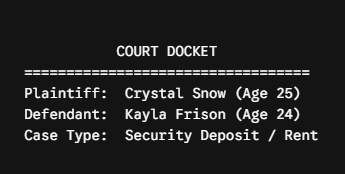
Crystal Snow initiated the lawsuit seeking $450—a figure calculated based on her claim to the original security deposit balance. Kayla Frison filed a counterclaim seeking a half-month’s rent ($150) to cover the period following Crystal’s abrupt departure on February 3rd.
Key Points Raised During Testimony:
- The Deposit Balance: Crystal paid $695 toward the initial $795 deposit. Kayla argued that damages were assessed by the landlord, but produced no written text messages or official invoices to prove damages existed.
- The Unpaid February Rent: Crystal acknowledged paying $0 for February rent, citing the two-day hot water outage and her departure on February 3rd.
- Notice of Intent: Crystal claimed to possess text messages proving she gave a two-week notice of her departure, which she argued Kayla had accepted.
When questioned about her documentation regarding tenant damages, Kayla admitted she had only communicated verbally or via unsubmitted text messages with the landlord. “Then you should have had a bill from her,” Judge Sheindlin admonished, establishing that oral assertions of property damage carry no weight without tangible evidence.
5. The Verdict and the Aftermath
Judge Judy Sheindlin evaluated the obligations of both parties under the contractual lease:
- Plaintiff’s Claim: Crystal was entitled to the return of her initial security deposit contributions ($795 full value considered in the primary baseline calculation).
- Defendant’s Counterclaim: Because Crystal occupied the apartment during February without paying rent, Kayla was legally entitled to offset half a month’s rent ($150).
Subtracting the $150 rent owed by Crystal from the baseline security deposit allocation, Judge Sheindlin issued a final ruling:
JUDGMENT: Awarded to Plaintiff Crystal Snow in the amount of $645.00. Defendant’s counterclaim for half-month rent was satisfied via deduction.
Outside the courtroom, the financial matter was legally concluded, but the familial bond was permanently severed. In post-verdict interviews, Kayla reflected bitterly on the rift, revealing that Crystal no longer attends family gatherings.
“She made my life a living hell,” Kayla stated, maintaining that she had been unfairly portrayed. What began as a hopeful shared living arrangement ended in a public judicial ruling, leaving two cousins completely estranged.
FAQ
Why did Crystal Snow sue Kayla Frison in small claims court?
Crystal Snow sued her cousin Kayla Frison to recover money owed for an apartment security deposit after Crystal vacated the property following a dispute over rooming arrangements and new occupants.
What was Kayla Frison’s counterclaim in the lawsuit?
Kayla Frison counter-sued Crystal Snow for half a month’s rent ($150) because Crystal moved out on February 3rd without paying rent for that month.
How much money did Judge Judy award to Crystal Snow?
Judge Judy awarded Crystal Snow $645.00. This was calculated by taking the security deposit entitlement and deducting $150 owed to Kayla for half a month’s rent.
Did Kayla Frison prove that there was damage to the apartment?
No. Kayla claimed the landlord mentioned damages, but she failed to provide written receipts, repair bills, or text message evidence in court to substantiate her claim.
Sources
- Official Court Transcript & Video Subtitles: Snow v. Frison, Judge Judy Small Claims Court Proceedings (SRT Source File ID: 1).