Lexis Scales said she arrived with the final $60 in her hand. Minutes later, the license plates were being removed, the keys were demanded, and she was left beside the road without the car for which she had already paid $1,540. What reached the Judge Judy courtroom was not simply an argument over a late payment. It was a test of an informal sale, a missing title, and Charlotte Hammerschmidt’s claim that the repossessed Saturn had soon been given away for nothing.

A Used Car That Was Not Yet Paid Off
The dispute began with a silver 2004 Saturn and a seller who wanted it gone.
Charlotte Hammerschmidt told the court that she had bought the vehicle from Five Star Auto Sales in Mount Zion, Illinois, on July 3, 2015. The purchase price was $3,400, financed through what she described as a “buy here, pay here” arrangement. That detail became central because Charlotte had not finished paying the dealership when she later offered the Saturn for sale.

In February, Charlotte advertised the car for $1,900. She ultimately agreed to sell it to Lexis Scales for $1,600. Asked why she would accept such a substantial loss only months after buying it, Charlotte said the vehicle carried memories of a relationship she had expected to last. When that relationship ended, she wanted to remove those reminders from her life.

That explanation supplied a motive for selling quickly, but it did not resolve the financial problem underneath the deal: Charlotte was selling a car whose title was still tied to an unpaid balance.
The $1,000 Down Payment and the Missing Title
Lexis testified that the agreement had two stages. She would first pay Charlotte $1,000. Charlotte would use that money to pay off the Saturn. Lexis would then pay the remaining $600, after which Charlotte would transfer the title.

The women went together to the dealership. A man from the business discussed both the Saturn and another vehicle Charlotte was considering buying. Yet Lexis acknowledged that she did not ask the dealership whether her $1,000 would actually clear the balance on the Saturn.

That missed question left the transaction dependent on trust. Lexis had possession of the car, registration paperwork, and insurance documentation, according to the testimony, but she did not have the title. Charlotte remained the link between Lexis and the dealership that still had a financial interest in the vehicle.

The hearing also showed why the car mattered to Lexis. She told the judge that she was not working at the time, lived with her mother, was studying to become a certified nursing assistant, and cared for her two-year-old daughter. The court did not treat those circumstances as a substitute for proof. Instead, it examined the payment record and messages Lexis brought with her.
Five Months of Use, With $60 Left
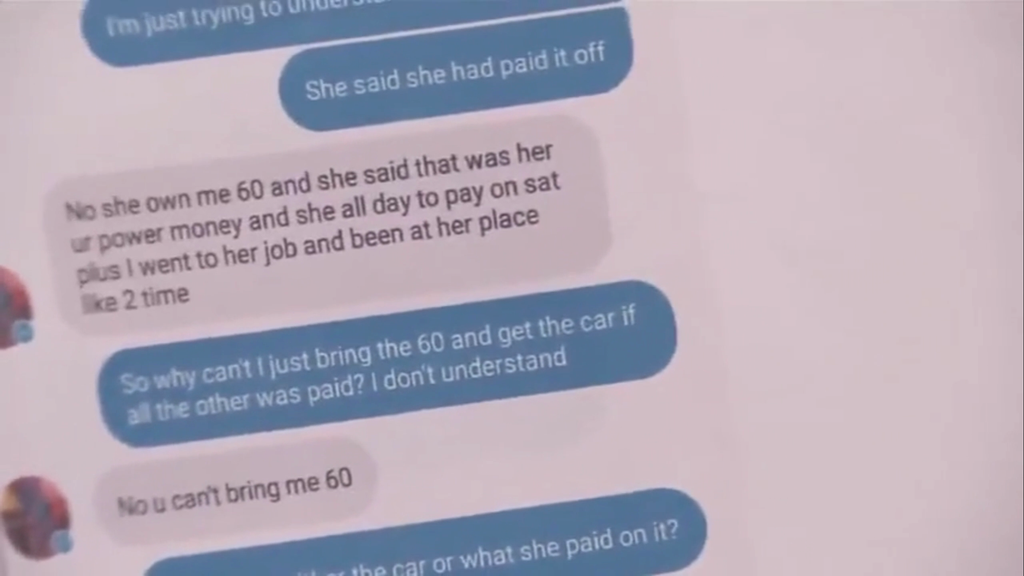
By the time the relationship between buyer and seller collapsed, Lexis had paid $1,540 of the agreed $1,600 price. She produced a payment timeline and screenshots that she said confirmed the payments.
Only $60 remained.

Charlotte described a repayment schedule under which the final $600 should have been paid in three monthly installments of $200, with the balance cleared in May. Lexis, however, had used the Saturn for about five months, and the surviving messages persuaded the judge that she still wanted to deliver the last payment.

The distinction mattered. This was not a case in which a buyer had paid little, disappeared, and continued using the property indefinitely. Nearly the entire sale price had changed hands. The conflict turned on what Charlotte did when the final fraction of that price was not in her mailbox at the time she expected it.

June 27: The Repossession
Charlotte said she gave Lexis all day Saturday to bring over the $60. When Charlotte returned home at approximately 10:30 or 11 p.m., she said there was no money in the mailbox. Early on June 27, she took the car back.

Their accounts converged on several important points. Lexis drove the Saturn to Charlotte’s location. Charlotte directed Larry Bartley—identified during the hearing as her boyfriend—to remove the license plates. Charlotte then regained possession of the car.

Lexis’s post-hearing account added a sharper picture of the encounter. She said she had the $60 with her and attempted to pay it, but Charlotte refused. According to Lexis, she was told to find another way home and was left by the roadside. Those details were Lexis’s account, not independently established facts. Still, the judge had reviewed the parties’ messages and concluded that Lexis wanted to make the payment while Charlotte did not want to accept it.

The court therefore focused less on whether the $60 had been deposited by a particular hour and more on the proportionality and purpose of the repossession. Charlotte had recovered a car after receiving all but $60 of its sale price.
The Car’s Transfer to Mr. Mooney

What happened next became the most difficult part of Charlotte’s explanation.
Charlotte said she gave the Saturn to Mr. Mooney, a roommate who lived with her and Larry Bartley. Bartley testified that he had known Mooney for about 20 years and believed Charlotte had known him for roughly the same period. Both men worked in construction. Charlotte said the transfer cost Mooney nothing and that the title was placed in his name in July, after she had kept the repossessed car for approximately 15 days.
The judge tried to contact Mooney during the hearing, but reached his answering machine. Without his testimony, the court was left with Charlotte’s claim that she had given away an asset that the courtroom’s Blue Book check valued at $1,550.

The judge did not believe that account. Her disbelief was not a criminal finding that a fraudulent transfer had occurred. It was a credibility determination in a civil dispute: Charlotte’s explanation did not persuade the court, especially when weighed against the car’s value, the money Lexis had already paid, and the close household relationship among Charlotte, Bartley, and Mooney.
Why the Evidence Undermined Charlotte’s Account
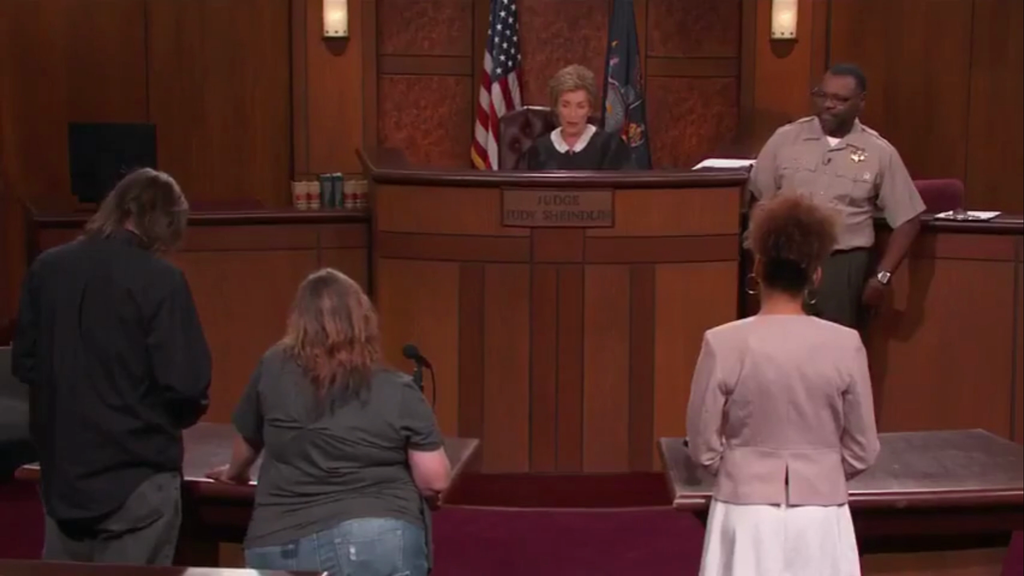
Several strands of evidence pointed in the same direction.
First, Lexis documented payments totaling $1,540. Second, the remaining debt was only $60. Third, the messages indicated that Lexis was trying to pay that balance. Fourth, Charlotte took the vehicle back and said it was then transferred for no payment to a longtime friend and roommate. Finally, the Saturn’s stated Blue Book value—$1,550—was almost identical to the amount Lexis had already paid.

Taken together, those facts made Charlotte’s position hard to sustain. She had both Lexis’s money and control of an asset of roughly equivalent value, while Lexis had neither the car nor title.
The judge used unusually direct language, calling Charlotte a “scam artist” and saying she believed Charlotte had scammed Lexis out of the money. Those were the judge’s courtroom characterizations of the conduct before her. The case itself remained a civil claim over money and property; the transcript does not show a criminal charge or conviction.

How the Court Reached a $1,000 Award
The court did not order the full $1,540 returned. Lexis had driven the Saturn for five months, and the judge assigned value to that use. She deducted $100 for each month, a total use allowance of $500, then entered judgment for Lexis in the amount of $1,000.

The numbers do not form an exact subtraction: $1,540 minus $500 equals $1,040. The ruling nevertheless set the award at an even $1,000. The most accurate reading is therefore that the judge credited Charlotte with $500 for Lexis’s use and then fixed the recoverable amount at $1,000, rather than presenting a precise accounting down to the final $40.

Charlotte had filed a counterclaim seeking compensation for damage to the car and punitive damages for stress. The judge declined to entertain it and dismissed the counterclaim. Her closing remark—that if the car was dirty, Mooney had received a dirty car as a gift—underscored the court’s rejection of Charlotte’s broader theory of loss.
What the Ruling Actually Established
The ruling resolved a narrow civil dispute. It established that Lexis was entitled to $1,000 after the court accounted for her five months of using the Saturn. It rejected Charlotte’s counterclaim and her attempt to justify keeping the payments while transferring the car elsewhere.

It did not establish that Charlotte committed a crime. Nor did it answer every question about the title transfer or the dealership’s remaining balance. Mr. Mooney never testified, and the transcript does not contain dealership records showing precisely how Charlotte used Lexis’s down payment.
What the record does show is how quickly an informal used-car deal can become unstable when the seller still owes money on the vehicle. Lexis paid nearly the entire agreed price without obtaining title. Charlotte responded to the final $60 dispute by taking back the car. Once that happened, the paper trail—and the plausibility of what happened to the Saturn afterward—became decisive.

For Lexis, the hearing ended with relief rather than recovery of the vehicle. She said she was glad the case was over and that she would receive money back. The road to that result began with $60 in dispute, but the judgment turned on the $1,540 already paid and the car that was no longer hers to use.
FAQ
Lexis Scales was the plaintiff. She sued Charlotte Hammerschmidt for the return of money paid toward the Saturn and for punitive damages after Charlotte repossessed it. Charlotte filed a counterclaim for alleged car damage and stress.
The agreed sale price was $1,600. Lexis presented proof that she had paid $1,540, leaving a final balance of $60.
Charlotte said Lexis failed to leave the final $60 by the deadline she had set. The judge found that messages showed Lexis wanted to pay and that Charlotte refused the money before taking the car back.
Charlotte testified that she gave the car to her roommate, Mr. Mooney, for no payment and transferred the title to him in July. The judge attempted to call Mooney but reached an answering machine, and she did not believe Charlotte’s explanation.
The judge awarded Lexis $1,000. She valued Lexis’s five months of driving the vehicle at $100 per month and used that allowance when reducing the amount recoverable from the $1,540 paid.
The court dismissed it. Charlotte had sought damages for the Saturn’s condition and punitive damages for stress, but the judge declined to entertain those claims.
No criminal conviction appears in the source material. This was a civil television-court dispute. Although the judge used the words “scam artist” and “scammed” when assessing Charlotte’s conduct and credibility, those remarks should not be presented as a criminal verdict.
Sources
- Primary source: E8.1.srt, the complete 298-cue subtitle transcript supplied for this article. All testimony, dates, names, payment amounts, quotations, and the judgment were checked against that file.
- Simkl — Judge Judy, Season 21, Episode 66: confirms the episode title, November 10, 2016 air date, and episode synopsis describing a repossession over the final $60.
Editorial note: The supplied SRT splits the surname as “Hammer Schmidt” in the introduction but renders it as “Hammerschmidt” when the judge addresses Charlotte later. This article uses the closed form while preserving the name exactly as it appears in that later cue. The external episode listing confirms the segment metadata but does not name the litigants.